Salesforce Open CTI is Retiring in Feb 2028. Start planning early with a Free Assessment!

Agentforce Contact Center: Salesforce Enters a New Era of AI-Driven Customer Experience
Salesforce’s new Agentforce Contact Center announcement signals a major shift in how AI will power customer interactions. In this article, we explore how AI voice agents, CRM-driven automation, and evolving telephony integrations could reshape the future of contact centers - and what it means for organizations evaluating their technology stack.
3/11/20264 min read
What Salesforce’s AI Push Means for the Future of Customer Experience
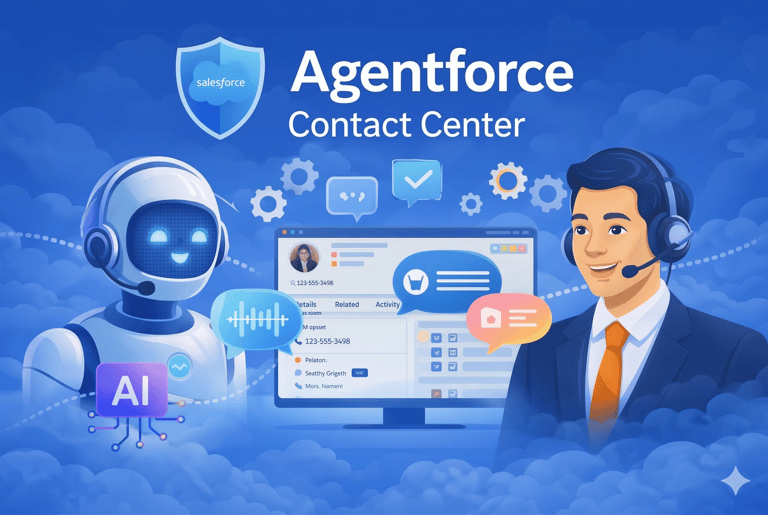
Salesforce recently made waves in the contact center industry with the announcement of Agentforce Contact Center, a platform initiative aimed at bringing AI agents, CRM data, and customer service workflows closer together.
The announcement reflects a broader trend that has been accelerating across the industry: AI is rapidly becoming a core component of contact center operations.
For years, AI has been helping human agents work more efficiently through capabilities like:
Real-time transcription
Automated conversation summaries
Knowledge article recommendations
Sentiment analysis
Next-best action guidance
But the newest generation of AI tools goes much further.
Today’s AI systems are beginning to resolve customer interactions independently, particularly through AI voice agents and conversational automation.
Salesforce’s Agentforce announcement signals that the company intends to play a major role in shaping that future.
AI Is Expanding Beyond Agent Assistance
Historically, AI in the contact center was primarily about assisting human agents.
That model is now evolving.
The next phase of AI in customer experience involves AI agents interacting directly with customers. These systems can leverage CRM data, business rules, and company knowledge to handle tasks such as:
Answering common customer questions
Authenticating customers
Retrieving account information
Scheduling appointments or service requests
Escalating issues to human agents when necessary
With Salesforce deeply embedded as the system of record for customer data, it makes sense that Salesforce wants AI agents to operate directly on top of that information.
In theory, an AI agent powered by Salesforce could access:
Customer history
Purchase records
Service cases
Loyalty status
Account preferences
All of this context allows AI interactions to become more personalized and effective.
The Rise of AI Voice Agents
One of the most interesting aspects of Salesforce’s direction is the focus on AI voice interactions, often referred to as AI voice agents.
Traditional IVR systems were designed around rigid menu structures that often frustrated customers. Modern AI voice agents, however, are capable of:
Natural conversational dialogue
Real-time understanding of intent
Pulling contextual information from CRM systems
Performing automated tasks within business systems
This opens the door to significant call deflection, where routine customer interactions can be handled automatically without human intervention.
For high-volume contact centers, this could dramatically improve efficiency and reduce operational costs.
The CCaaS Market Has Been Investing in AI for Years
While Salesforce is making headlines with Agentforce, it’s important to recognize that AI innovation is already well underway across the CCaaS industry.
Major contact center providers have been investing heavily in AI capabilities such as virtual agents, real-time agent coaching, predictive analytics, automated quality monitoring, workforce management and more. Some of our partner providers include:
NICE
Zoom
Genesys
RingCentral
Five9
Talkdesk
These platforms have decades of experience managing large-scale contact center operations, including telephony infrastructure, routing systems, and global service reliability.
As Salesforce expands further into contact center territory, the market will be watching closely to see how these ecosystems evolve together.
A Strategic Shift Away From Open CTI
Another factor that makes the Agentforce announcement particularly interesting is its alignment with Salesforce’s broader telephony strategy.
Salesforce has already announced plans to retire Open CTI in February 2028. Open CTI is the long-standing integration framework used by many phone system providers to connect with Salesforce.
In its place, Salesforce is moving toward Salesforce Voice integrations and licensing models, which more tightly couple telephony with the Salesforce platform.
Agentforce Contact Center fits squarely into that strategy.
This shift raises an important architectural question for organizations that rely on Salesforce for CRM:
Where should contact center intelligence and AI capabilities live?
Will they primarily reside inside Salesforce? Or will they remain part of specialized CCaaS platforms that integrate with Salesforce?
We think this will be a hybrid of both depending on the use case and ease of build/maintenance.
The Debate: Platform Consolidation vs. Best-of-Breed
The idea of consolidating everything (telephony and CRM systems) into a single platform is appealing on the surface.
A single system that manages CRM, telephony, AI, analytics, and automation can seem simpler.
But in reality, many organizations intentionally maintain decoupled technology stacks.
A decoupled architecture can also make it easier to adopt new technologies as the market continues to evolve. In other words, 'putting all eggs in one basket' may not always be the best long-term strategy.
Separating CRM from telephony infrastructure allows companies to:
Choose best-of-breed solutions
Avoid vendor lock-in
Maintain flexibility as technology evolves
Reduce risk by not depending on a single platform provider
Salesforce Is Not Traditionally a Contact Center Platform
Salesforce is one of the most powerful CRM platforms in the world.
However, it has historically not been the system responsible for operating core telephony infrastructure.
Dedicated CCaaS providers have built their reputations over decades by focusing on mission-critical capabilities such as:
Telephony uptime and redundancy
Advanced call routing
Workforce management
Global carrier connectivity
Contact center analytics
Operational monitoring tools
As Salesforce moves deeper into this space with Agentforce Contact Center, organizations will naturally evaluate how the platform compares to providers that have specialized in contact center technology for years.
The Contact Center of the Future
The future of customer experience will likely involve multiple AI layers working together across platforms.
Organizations may leverage:
Salesforce for CRM data, workflows, and automation
CCaaS platforms for telephony and routing
AI agents operating across both environments
This hybrid architecture allows businesses to take advantage of the strengths of each system while maintaining flexibility as technology continues to evolve.
How CommCorrect Helps Companies Navigate the Shift
With AI evolving rapidly and platform strategies shifting across the industry, many organizations are asking an important question:
What should our contact center architecture look like moving forward?
At CommCorrect, we help companies answer that question.
Our team combines Salesforce architecture expertise with deep knowledge of cloud communications platforms to help clients evaluate technologies such as:
Salesforce Voice integrations
AI voice agents
CCaaS platforms
Salesforce CTI alternatives
CRM-driven customer engagement strategies
We help organizations understand the tradeoffs between platform options and design a technology stack that supports both today’s needs and tomorrow’s innovations.
Free Contact Center Technology Assessment
AI is reshaping the contact center faster than ever before.
Between Agentforce, AI voice agents, evolving CCaaS platforms, and Salesforce’s telephony strategy changes, now is the perfect time to evaluate your organization’s long-term roadmap.
CommCorrect offers a free technology assessment to help companies determine how their contact center platform should evolve in the years ahead.
The future of customer experience will be driven by AI and the key is making sure your architecture is ready for it.


CommCorrect Technologies, LLC
5233 Driscoll Court, Orlando, FL 32812
© 2026 CommCorrect Technologies, LLC. All rights reserved.