Salesforce Open CTI is Retiring in Feb 2028. Start planning early with a Free Assessment!
Not All CCaaS Platforms Are The Same
Not every contact center platform delivers the same mix of features, pricing, AI, analytics, workforce management, CRM integration, and support. This article explores how businesses should evaluate CCaaS providers based on their own goals, budget, operational complexity, and long-term technology strategy. It also highlights why choosing the right platform requires looking beyond feature lists to find the best fit for your unique environment.
CCAASSALESFORCECXGENERAL INFORMATION
3/18/20267 min read
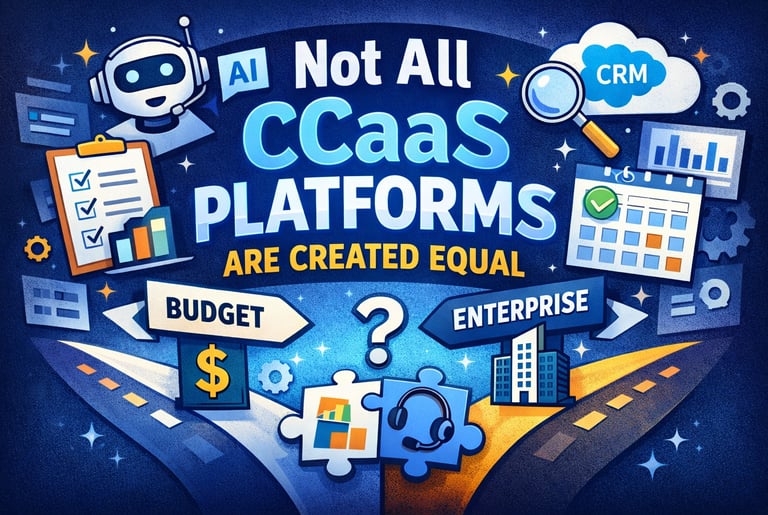
Not All CCaaS Platforms Are Created Equal: How to Choose the Right Contact Center Technologies for Your Business
Choosing a contact center platform is no longer just about getting calls in and out of a queue. Today’s CCaaS landscape is filled with providers that look similar on the surface but differ dramatically once you get into the details that matter most: pricing models, AI capabilities, reporting depth, workforce management, CRM integration, support quality, and long-term scalability.
That is why selecting a provider should never be based solely on brand recognition, a polished demo, or a low entry price. The right choice depends on your business model, your customer experience goals, your existing technology stack, and where you expect your operation to be in the next several years.
At CommCorrect, we often remind clients of one simple truth: the best platform is not the one with the longest feature list; it is the one that best aligns to your requirements, budget, operational model, and long-term strategy.
The Market Is Crowded
The CCaaS market has matured quickly. There are now providers focused on enterprise complexity, providers designed for fast deployment and affordability, providers built around digital engagement, and providers leaning heavily into AI transformation. Many can handle core voice and routing. Many offer chat, SMS, and omnichannel capabilities. Many claim deep analytics, automation, and integrations.
But once you move beyond the headline features, the differences become much more important.
Some platforms offer a strong core contact center product at an attractive price point, but require extra licensing for advanced AI, analytics, quality management, or workforce management. Others may look more expensive at first glance, but include more functionality out of the box and reduce the need for bolt-on products. Some have robust built-in capabilities for forecasting, scheduling, QA, and performance tracking. Others depend on third-party tools to close those gaps.
In other words, two platforms may both be called “contact center solutions,” but the experience of owning, administering, integrating, and scaling them can be completely different.
Pricing Is Only One Piece of the Equation
Budget always matters. For some organizations, affordability is the primary driver. A smaller business may be perfectly comfortable starting with a lighter platform that delivers the core capabilities they need today: voice, basic routing, a few digital channels, and enough reporting to manage the operation.
That can be a smart decision.
Not every business needs enterprise-grade workforce optimization on day one. Not every business needs AI voice agents immediately. Not every business needs a complex omnichannel orchestration strategy across multiple business units.
For these organizations, it may make sense to prioritize low cost, simplicity, and speed to deploy - while understanding where the platform may require add-ons later.
But for other companies, especially those making a strategic investment that is expected to remain in place for five or more years, the “lowest starting price” can become the most expensive choice in the long run. If advanced capabilities are carved into separate licenses, if reporting depends on external tools, or if key functionality must be stitched together through third parties, the total cost of ownership can rise quickly.
This is where many buying teams get tripped up. They compare license prices without fully comparing the platform architecture behind those prices.
AI Is a Perfect Example of Why Deeper Evaluation Matters
AI is now one of the most important categories to evaluate in any modern contact center decision.
Some providers are delivering meaningful AI capabilities directly within the platform, such as agent assist, call summarization, sentiment detection, knowledge recommendations, intelligent routing, and customer-facing voice or chat automation. Others may advertise AI capabilities, but the actual functionality requires separate modules, premium licenses, third-party products, or significant implementation effort.
If your goal is to start lean and introduce AI over time, a provider with optional AI packaging may fit your needs well. But if your organization expects AI to be central to service operations, cost reduction, deflection strategy, or agent productivity from the beginning, then it is critical to understand exactly what is native, what is extra, and what is still evolving.
The same is true for AI governance. Businesses should ask where AI is being configured, how it interacts with knowledge and CRM data, how outcomes are measured, and whether the AI strategy aligns with the rest of the customer experience architecture.
Reporting and Analytics Can Be a Hidden Differentiator
Reporting is another area where platform differences show up fast.
Some providers offer rich dashboards, historical analytics, operational reporting, and quality insights directly within the platform. Others may have more limited native reporting and rely on exporting data into external BI tools or separate reporting solutions. Neither model is automatically wrong - it depends on your needs.
If your leaders want quick access to queue trends, handle times, agent performance, and channel activity without adding more tools, then strong native analytics may be essential. If your business already has a mature data and BI strategy, you may be comfortable pulling contact center data into an enterprise reporting environment.
The key is knowing which model you are buying into before the contract is signed.
Too many organizations discover late in the process that the analytics story they expected is either more limited than they thought or more expensive than they planned.
Workforce Management and Quality Management Are Not Always Included
This is another category where assumptions can create problems.
Some CCaaS providers include or tightly bundle workforce management, quality management, forecasting, scheduling, and performance tools. Others depend on partner ecosystems or separate product families.
If you run a more sophisticated support operation, workforce tools may not be optional. Forecasting, adherence, intraday management, coaching, and quality programs all become increasingly important as scale grows. A platform that lacks maturity here may still work, but only if your organization is prepared to manage the added complexity of third-party solutions.
That may be acceptable for some businesses and it may be a non-starter for others.
CRM Integration Can Be a Strategic Requirement, Not Just a Nice-to-Have
For organizations using Salesforce or another CRM as a central operating platform, integration quality can become one of the most important factors in the buying decision.
Some contact center providers have invested deeply in Salesforce integration, including screen pops, call controls, activity logging, workflow enablement, and alignment with Service Cloud Voice and Bring Your Own Telephony (BYOT) models. Others have more basic integrations, or they have chosen not to prioritize certain Salesforce architecture paths yet.
This is a major consideration for businesses that want agents working natively inside Salesforce, want customer interactions tightly connected to CRM data, or see the contact center as part of a broader service transformation strategy.
If CRM is mission-critical to your operation, the contact center platform cannot be evaluated in isolation. It must be evaluated as part of your CRM ecosystem, your service workflows, your reporting model, and your future-state architecture.
Support and Partnership Still Matter More Than Many Buyers Expect
Feature sets get most of the attention during evaluations, but support quality often becomes one of the biggest drivers of long-term satisfaction.
Some providers have strong implementation teams, responsive support organizations, and a real customer success motion. Others struggle with consistency, escalation handling, or post-sale partnership.
This matters because no contact center platform is ever truly “set and forget.” These platforms evolve. Business requirements change. New channels are added. AI capabilities mature. Routing logic gets more complex. Integrations need refinement. Reporting needs shift.
When that happens, the quality of the vendor relationship becomes just as important as the software itself.
The Right Platform Depends on the Kind of Business You Are
This is why the provider decision should always begin with a clear understanding of your own business.
Are you a growing company that needs to control costs, move quickly, and start with core functionality now? If so, a lower-cost platform with room to expand later may be the right fit.
Are you a large enterprise making a strategic investment that will shape customer experience operations for the next five years or longer? Then platform depth, scalability, governance, integration maturity, and vendor stability likely deserve far more weight than entry pricing.
Will the system be used only by contact center agents, or will employees across the company also rely on it for telephony and collaboration? If broad adoption matters, then platform consolidation becomes part of the business case.
Is Salesforce central to how your teams work? Then integration maturity is not a side consideration; it is a core requirement.
Do you expect AI to be introduced gradually, or do you need it to drive transformation from the start? That answer alone can significantly narrow the field.
A Better Selection Process Starts With Better Questions
Too many evaluations begin by comparing vendor checklists. A stronger approach is to first define what your business is really trying to achieve.
That includes questions like:
What channels do we need now versus later?
How important is native AI versus optional AI?
Do we need built-in workforce management?
How strong does native reporting need to be?
Is Salesforce integration a requirement or just a convenience?
Do we want one unified platform for contact center and office telephony?
What level of vendor support and partnership will we need after go-live?
Are we optimizing for cost today, or for strategic fit over the next five years?
When these questions are answered clearly, the market becomes much easier to navigate.
Final Thoughts
The contact center platform market is full of strong options, but they are not interchangeable.
Some are built for affordability and simplicity. Some are built for enterprise complexity. Some stand out in AI. Some shine in analytics. Some bring strong workforce tools. Some offer better Salesforce alignment. Some win on support and partnership. And some check only part of the box.
The goal is not to find the “best” provider in the abstract. The goal is to find the right provider for your business.
That means understanding your current requirements, your budget reality, your operational maturity, your CRM strategy, and your future roadmap before you make a decision that could shape your customer experience platform for years to come.
At CommCorrect, that is exactly where we help clients focus: cutting through the noise, comparing providers based on real-world requirements, and helping organizations select a platform that actually fits.
Use the interactive provider comparison widget below (Desktop only) to explore how leading platforms differ across pricing, AI, analytics, workforce management, Salesforce integration, and more.
CommCorrect Technologies, LLC
5233 Driscoll Court, Orlando, FL 32812
© 2026 CommCorrect Technologies, LLC. All rights reserved.