Salesforce Open CTI is Retiring in Feb 2028. Start planning early with a Free Assessment!

Salesforce Open CTI Retirement in February 2028
Salesforce has officially announced their retirement of the Open CTI call center integration framework. This leaves thousands of companies with major decisions to make before the 2028 deadline. Service Cloud Voice or external integration? Existing phone system, or migrate to new provider? We are here to help you navigate through the process!
SALESFORCECCAASGENERAL INFORMATIONSALESFORCE INTEGRATION
2/12/20264 min read
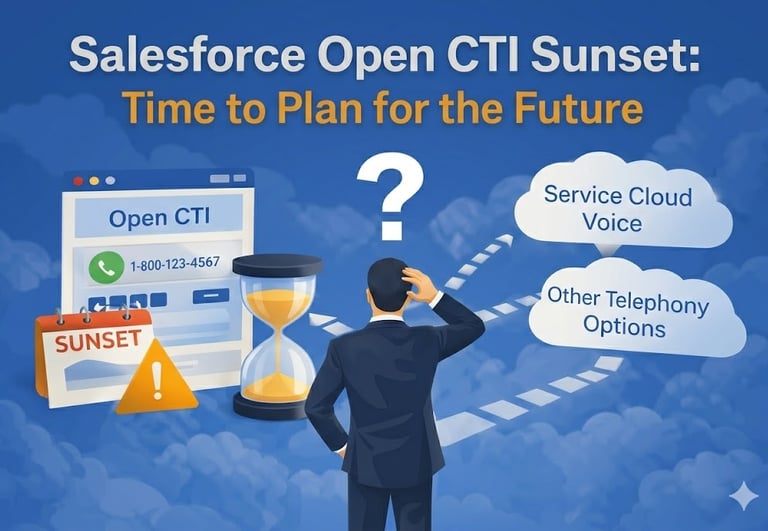
Open CTI Is Going End-of-Life: What It Means for Your Contact Center Strategy
Salesforce has officially put a clock on Open CTI. For years, Open CTI has been the backbone of how many organizations integrated their phone systems with Salesforce. CTI adapters, click-to-dial, screen pops, call logging into Tasks—this pattern has been the standard.
Now there’s an end-of-life timeline, and while Salesforce has provided roughly a two-year runway, the message is clear:
The way telephony integrates with Salesforce is changing—permanently.
If your contact center, sales floor, or outbound team relies on Open CTI today, this is not something to leave for “someday.” Let’s unpack the key implications and what you should be doing now to prepare.
The Impact: More Than Just an Adapter Swap
This is not a simple “uninstall old CTI package, install new one” situation. The shift away from Open CTI touches multiple layers of your stack.
1. Service Cloud Voice (SCV) Licensing & Pricing
Salesforce’s strategic direction for native telephony is Service Cloud Voice (SCV) and Agentforce Voice. For many orgs, that means:
New license requirements (SCV SKUs or equivalent)
Potentially higher costs compared to a pure BYO-telephony + Open CTI model
Decisions around whether to use Salesforce’s native/carrier options or a Bring Your Own Telephony (BYOT) integration model
For some customers, SCV will be the right move. For others, especially where margins are tight or where heavy outbound and advanced dialer features matter, the cost model may push them toward alternative integration strategies.
2. Data Model Shift: Tasks → VoiceCall Objects
Most Open CTI integrations today log calls as Tasks (or a custom activity-style object). Salesforce’s newer model is to use VoiceCall records:
Reporting, automation, and analytics need to adapt to a new object
Flows, triggers, and dashboards built around Tasks may need to be refactored
Any downstream systems expecting Task-based call logs will need rework
If you’ve built years of logic on “Tasks = calls,” this is not trivial. You’ll need a migration strategy and a pattern for new development going forward.
3. Migrations: Technical and Operational
Moving off Open CTI means answering some tough questions:
How will we keep historical reporting intact when the data model changes?
What happens to our current softphone UI in Salesforce?
How will agents be retrained on SCV or a new embedded UI?
Which flows, Omni-Channel routing rules, and screen pops are tied to Open CTI specifics?
There’s both a technical migration and a change-management effort here. This is especially true for high-volume contact centers.
SCV or Not SCV? That Is the Question
A big part of your strategy will come down to which direction you choose:
Option 1: Move Toward Service Cloud Voice
Reasons this might make sense:
You want deep, native Salesforce alignment for voice and Agentforce.
Your existing provider supports SCV through a BYOT integration, or you’re open to changing providers.
You prioritize unified reporting on the VoiceCall object, Einstein capabilities, and tighter Salesforce roadmap alignment.
Challenges:
Licensing cost may be higher than your current setup.
Your current provider may not support SCV/BYOT, forcing a platform change.
You’ll need to retrain agents and rebuild certain parts of your architecture.
Option 2: Use a Different Integration Approach (Decouple)
For some organizations, the answer may be to de-emphasize direct dependence on Salesforce telephony frameworks and integrate via:
Embedded web apps within Salesforce
API-based syncing of call data (rather than live CTI)
External dialers and engagement tools that write back to Salesforce without fully relying on Open CTI or SCV
This can reduce your exposure to future Salesforce telephony strategy shifts and give you more flexibility in choosing providers, especially if you’re heavy on outbound dialing, advanced workflows, or have multi-CRM environments.
At CommCorrect, we used to view a tight Open CTI integration as the gold standard. With this EOL announcement and the directional push into SCV, we’re increasingly seeing value in decoupling telephony from Salesforce-specific CTI frameworks where it makes sense, while still maintaining strong data and workflow integration.
Why You Should Start Planning Now (Even with Two Years Left)
On paper, two years sounds like plenty of time. In practice:
Budget cycles, contract renewals, and procurement can easily consume 6–12 months.
Migrations and pilot programs will often take several quarters, especially in larger orgs.
You’ll want time to evaluate multiple providers and scenarios, not rush into a single path.
You may find that:
You want to move to SCV/Agentforce Voice, but your current provider doesn’t support BYOT → you’ll need to shop for a new provider.
You don’t want to go to SCV (pricing, feature gaps, strategy) → you’ll need a new integration pattern and possibly a provider that invests more in non-SCV options.
You’d like to run parallel pilots (e.g., SCV in one business unit, alternative integration in another) before standardizing.
All of that takes real time.
How CommCorrect Helps You Navigate the Transition
This is exactly the type of crossroads where a neutral advisor is invaluable.
At CommCorrect, we:
Bring deep Salesforce administration and solution architecture experience.
Map your current Open CTI footprint: data model, user flows, reporting, and integrations.
Help you evaluate SCV vs non-SCV paths, including cost, feature fit, and long-term flexibility.
Shortlist and vet providers that:
Support SCV/BYOT if that’s your direction, or
Offer strong standalone integrations and engagement tooling if you choose to decouple.
Coordinate pilots, demos, and technical deep dives so you can compare options in a structured, apples-to-apples way.
Advocate for you during vendor discussions and help negotiate best-possible pricing and terms.
Most importantly, we help you design a contact center and telephony strategy that isn’t brittle. Your system should be one that can adapt as Salesforce and the broader communications ecosystem continue to evolve.
Final Thought: Don’t Wait for the Deadline to Become a Crisis
Open CTI’s end-of-life is a big shift, but it doesn’t have to be a disaster. For many organizations, it’s actually an opportunity to:
Clean up legacy call flows and dependencies
Reconsider whether your current telephony provider is still the best fit
Decide how tightly you want to couple your voice stack to Salesforce going forward
But the organizations that come out ahead will be the ones that start planning now, not 90 days before the cutoff.
If you’re unsure where to begin (whether SCV is right for you, whether to change providers, or how to minimize migration risk), CommCorrect is here to help you navigate these waters and set your teams up for long-term success.
👉 Ready to talk about your Open CTI path forward? Reach out today for a no-cost strategy discussion.
CommCorrect Technologies, LLC
5233 Driscoll Court, Orlando, FL 32812
© 2026 CommCorrect Technologies, LLC. All rights reserved.